
Luxury bathroom tiles transform ordinary bathrooms into stunning personal retreats through premium materials, superior durability, and design versatility that standard tiles simply can’t match. High-end porcelain and natural stone tiles offer water absorption rates below 0.5%, exceptional scratch resistance, and timeless aesthetics that can last 50 years or more with proper care. When paired with large-format options that speed up installation and reduce maintenance, luxury tiles deliver both immediate visual impact and lasting value for your remodeling investment.
Key Takeaways
- Porcelain tiles with water absorption rates below 0.5% are classified as “impervious” and are the gold standard for bathroom wet areas, including showers and floors.
- Large-format tiles (15 inches or larger on one edge) reduce grout lines by up to 75% compared to standard tiles, cutting cleaning time and preventing mold growth.
- Premium porcelain tiles fired at temperatures around 2,250°F offer superior density and can withstand heavy foot traffic without showing wear for decades.
- Installing large-format tiles can actually speed up project timelines since fewer tiles are needed to cover the same area, reducing overall labor time.
- The 2026 bathroom tile trends favor natural stone looks, warm earth tones, and textured surfaces that create spa-like atmospheres while maintaining practical durability.
- What Makes a Bathroom Tile “Luxury Grade”?
- Porcelain vs. Ceramic: Which Performs Better in Bathrooms?
- Do Large-Format Tiles Actually Speed Up Installation?
- What Durability Features Should You Look for in Premium Tiles?
- What Are the Hottest Luxury Bathroom Tile Trends for 2026?
- Why Do Fewer Grout Lines Matter for Bathroom Maintenance?
- Comparing Your Luxury Tile Options
- Frequently Asked Questions
What Makes a Bathroom Tile “Luxury Grade”?
Luxury bathroom tiles distinguish themselves through three core characteristics: material composition, manufacturing precision, and aesthetic refinement. Premium tiles aren’t just prettier versions of standard options—they’re engineered to perform at a higher level in demanding bathroom environments.
The first marker of luxury is the raw material. High-end porcelain tiles are made from refined clay and fired at temperatures around 2,250°F, creating a denser, harder product than standard ceramic. This firing process results in tiles that are significantly less porous and more resistant to moisture, staining, and physical damage.
Manufacturing precision also separates luxury from basic. Premium tiles undergo rigorous quality control, including isostatic pressing and dimensional calibration that ensures each tile is perfectly flat and uniformly sized. This precision matters enormously during installation—it allows for tighter grout joints and a more seamless final appearance.
Finally, luxury tiles offer design options that standard products can’t replicate. Natural stone finishes with realistic veining, handcrafted textures like zellige, and large-format slabs that eliminate visual interruptions all fall into the luxury category. These tiles function as design statements, not just functional surfaces.
Porcelain vs. Ceramic: Which Performs Better in Bathrooms?
Porcelain outperforms ceramic in bathroom applications due to its superior water resistance and durability, though ceramic remains a viable choice for walls and lower-moisture areas. The difference comes down to density, porosity, and long-term performance under wet conditions.
Both materials start from clay and fire in a kiln, but porcelain uses a more refined clay mixture and fires at higher temperatures. According to industry standards from ANSI A137.1, porcelain tile must have a water absorption rate of 0.5% or less to earn that classification. Ceramic tiles typically absorb 3% to 10% or more, making them far more vulnerable to moisture penetration over time.
In practical terms, this means porcelain tiles won’t absorb water that could lead to discoloration, mold growth, or structural weakening. For shower floors, shower walls, and bathroom flooring that sees daily water exposure, porcelain is the safer long-term investment. Ceramic tiles work fine for accent walls or powder rooms that stay relatively dry.
Durability follows the same pattern. Porcelain’s dense composition makes it highly resistant to scratches, chips, and heavy foot traffic. Porcelain floors can last 50 years or more with proper care, according to industry sources. Ceramic tiles, while still durable, are more prone to chipping and may need replacement sooner in high-use areas.
Porcelain tiles fired at 2,250°F achieve water absorption rates below 0.5%—the industry definition of “impervious”—making them virtually immune to moisture damage in wet bathroom environments.
Do Large-Format Tiles Actually Speed Up Installation?
Yes, large-format tiles can reduce overall installation time because fewer individual pieces are needed to cover the same area. Each tile covers more square footage, which means less cutting, less positioning, and fewer grout lines to apply and finish.
Large-format tiles are defined as any tile with at least one edge greater than 15 inches. Popular sizes now include 18×36 inches, 24×48 inches, and even 48×48 inches for truly dramatic installations. Thanks to advances in manufacturing, tiles can now be produced as large as 5 by 10 feet.
The installation speed advantage comes with an important caveat: substrate preparation must be more precise. According to ANSI (American National Standards Institute) specifications, the substrate for large-format tile installation should have no more than 1/8 inch variance over 10 feet. Any depressions or high points that wouldn’t matter with smaller tiles become visible and problematic with large formats.
When the subfloor is properly prepared—flat, clean, and structurally sound—experienced installers can actually complete large-format projects faster than comparable small-tile jobs. Rapid-setting mortars designed for large tiles allow grouting in as little as three hours and can handle heavy traffic within 24 hours after grouting.
For homeowners, the key is hiring installers experienced with large-format tiles. The tiles themselves aren’t harder to work with, but they do require specific techniques like back-buttering and leveling systems to prevent lippage (uneven tile edges).
What Durability Features Should You Look for in Premium Tiles?
The most important durability metrics for bathroom tiles are water absorption rate, PEI (Porcelain Enamel Institute) hardness rating, and scratch resistance. Understanding these specifications helps you select tiles that will perform for decades, not just years.
Water absorption rate is the single most critical specification for bathroom tiles. Industry standards classify tiles into four categories based on absorption rates: impervious (less than 0.5%), vitreous (0.5% to 3%), semi-vitreous (3% to 7%), and non-vitreous (greater than 7%). For shower floors and bathroom areas with constant water exposure, impervious tiles are the only appropriate choice.
PEI rating measures surface hardness and wear resistance on a scale from 0 to 5. For residential bathroom floors with regular foot traffic, PEI 3 or higher is recommended. Commercial or high-traffic residential spaces should use PEI 4 or 5 tiles. Ceramic tiles with a PEI rating of 4 or 5 approach porcelain-level durability.
Slip resistance matters significantly in wet bathroom environments. Look for tiles with a coefficient of friction (COF) of 0.60 or greater for bathroom floors. Many luxury tiles now incorporate textured finishes or specialized coatings that improve traction when wet without sacrificing aesthetic appeal.
Scratch and chip resistance correlate directly with tile density. Porcelain’s dense composition makes it highly resistant to scratches, chips, and surface wear. This becomes especially important in households with pets, children, or heavy bathroom furniture.
What Are the Hottest Luxury Bathroom Tile Trends for 2026?
The 2026 bathroom tile trends are moving away from cold, ultra-minimal spaces toward something more tactile, layered, and warm. Design experts are embracing natural materials with visible variation, richer colors, and artisanal finishes that make bathrooms feel like personal sanctuaries.
Natural stone looks with bold veining: Marble remains a foundation in bathroom design, but 2026 favors deeply veined slabs with high contrast and movement. Calacatta Viola, with its striking plum, green, and gold veining, exemplifies this trend toward more expressive stone patterns.
Limestone and travertine-inspired tiles: Stone-inspired tiles featuring limestone and travertine effects are among the most popular choices for 2026. These tiles add tactile texture while featuring the warm, earth-tone color palette that dominates current design.
Tile drenching: This trend embraces using the same tile across floors, walls, and shower areas, creating a continuous, uninterrupted flow throughout the bathroom. Large-format tiles with minimal grout lines enhance this seamless effect while adding both durability and elegance.
Textured and fluted tiles: Fluted tiles with rounded, linear profiles create multi-dimensional wall surfaces that catch light and add visual interest. These tiles offer a tactile quality that flat surfaces can’t match.
Onyx and onyx-effect porcelain: Onyx is emerging as a new statement material for 2026. Its natural translucency and rich veining create dramatic focal points. Onyx-effect porcelain tiles deliver similar aesthetics with improved durability and lower maintenance requirements.
Heated tile floors: According to Fixr.com, 54% of design experts identify heated tile floors as a top bathroom trend for 2026. Natural stone and porcelain tiles both conduct heat efficiently, making them ideal pairings with radiant floor systems.
Why Do Fewer Grout Lines Matter for Bathroom Maintenance?
Fewer grout lines mean less maintenance, better hygiene, and a cleaner visual appearance over the life of your bathroom. Grout is porous—even sealed grout absorbs moisture, collects dirt, and provides a surface where mold and mildew can grow.
Large-format tiles dramatically reduce the total linear footage of grout in your bathroom. A floor covered with 24×24-inch tiles has approximately 75% fewer grout lines than the same floor covered with 6×6-inch tiles. That’s 75% less surface area collecting grime, 75% less scrubbing during cleanings, and 75% fewer opportunities for mold growth.
The hygiene benefits extend beyond aesthetics. In bathroom environments with constant humidity and moisture, grout lines can harbor bacteria and mold even with regular cleaning. Large-format tiles with minimal grout lines reduce the potential for these problems and make maintaining a truly clean bathroom much simpler.
From a visual standpoint, fewer grout lines create a more seamless, contemporary appearance. The eye isn’t interrupted by grid patterns, allowing the tile’s natural beauty—whether marble veining, wood grain texture, or solid color—to take center stage. This clean look also makes smaller bathrooms appear more spacious by eliminating visual fragmentation.
Comparing Your Luxury Tile Options
Choosing the right luxury tile depends on your specific bathroom conditions, design preferences, and budget. This comparison breaks down the key differences between the most popular premium tile materials.
| Feature | Premium Porcelain | Natural Marble | Engineered Stone | High-End Ceramic |
|---|---|---|---|---|
| Water Absorption | <0.5% (impervious) | 0.1–0.5% (varies) | <0.5% (impervious) | 3–7% (semi-vitreous) |
| Best Bathroom Use | Floors, showers, walls | Feature walls, vanities | Floors, countertops | Walls, accent areas |
| Durability | Excellent (50+ years) | Good (requires sealing) | Excellent | Good (PEI 4-5) |
| Maintenance Level | Low | Medium-High | Low | Low-Medium |
| Large Format Available | Yes (up to 60×120″) | Yes (slabs) | Yes | Limited options |
| Price Range | $$-$$$ | $$$-$$$$ | $$-$$$ | $-$$ |
For most homeowners planning a bathroom remodel, premium porcelain offers the best combination of durability, water resistance, design options, and value. Natural marble creates stunning feature walls but requires more maintenance and sealing. High-end ceramic works well for decorative applications in drier areas.
Frequently Asked Questions
How Do I Choose the Right Grout Color for Luxury Tiles?
Match your grout color to the dominant tone in your tile for a seamless, monolithic appearance that emphasizes the tile’s natural patterns. Contrasting grout draws attention to the grid pattern and individual tile shapes, which works well for decorative mosaics but undermines the seamless look most homeowners want from large-format luxury tiles. For marble-look porcelain, choose a grout that matches the tile’s background color rather than the veining.
Can Luxury Tiles Be Installed Over Radiant Floor Heating?
Porcelain and natural stone tiles are ideal for radiant floor heating because they conduct and retain heat efficiently. The key is using appropriate installation materials—flexible thin-set mortars that can handle thermal expansion and contraction without cracking. Check the tile manufacturer’s specifications for compatibility with radiant systems, and ensure your installer has experience with heated floor installations.
Do Porcelain Tiles Need to Be Sealed?
Most quality porcelain tiles do not require sealing because their low porosity makes them naturally resistant to staining and moisture penetration. However, the grout between tiles should still be sealed with a penetrating grout sealer to prevent discoloration and water absorption. Some textured or matte-finish porcelain tiles may benefit from sealing—check with your tile supplier for specific recommendations.
Are Luxury Bathroom Tiles Worth the Higher Cost?
The higher upfront cost of luxury tiles typically pays off through longer lifespan, lower maintenance, and better resale value. While premium porcelain costs more per square foot than standard ceramic, it can last 50 years or more compared to 20-25 years for basic tiles. You’ll also spend less time and money on cleaning, repairs, and replacement over the life of your bathroom. For a space you use daily, the difference in quality is noticeable and lasting.
Should I Hire a Professional for Large-Format Tile Installation?
Yes, large-format tiles should be installed by experienced professionals. These tiles require precise substrate preparation with flatness tolerances of 1/8 inch over 10 feet, proper handling techniques to prevent breakage, back-buttering for full mortar coverage, and leveling systems to eliminate lippage. A DIY installation mistake with expensive large-format tiles can be costly to fix. Professional installers familiar with current ANSI standards will ensure your investment performs as intended.
Ready to Explore Premium Tile Options for Your Bathroom?
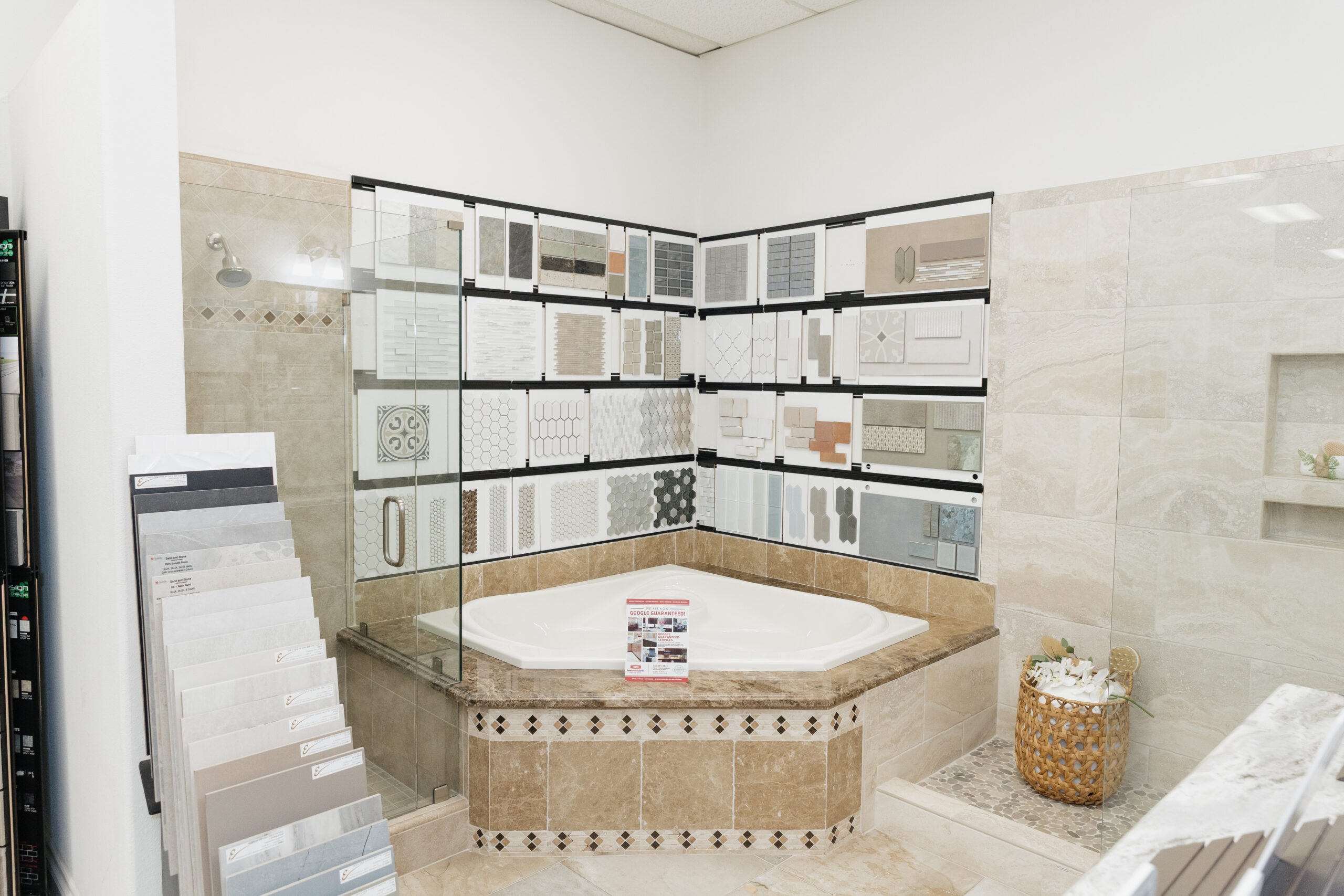
Home Remodeling Center carries a curated selection of luxury bathroom tiles—from large-format porcelain slabs to natural stone and trending textured finishes. Our design team can help you select tiles that match your style, fit your budget, and perform beautifully for decades. Visit our showroom to see and touch the materials, or schedule a consultation to discuss your bathroom remodeling project with our specialists.